

19 August 2016
Last updated at 10:07
 We used Terrafirma's unique mineral extraction map, Terrasmart, to uncover the hidden legacy of mineral extraction in Derbyshire.
Exploiting the array of mineral veins extant, lead mining has been extensively undertaken throughout central Derbyshire, with activity stretching from Ashbourne, northward across much of the Peak District National Park, to near Chapel-en-le-Frith. This activity has a long history, encompassing over a thousand years, with almost continuous working recorded from Roman times until the late 19th Century, the last concern, Magpie Mine not ceasing until 1956.
 |
|
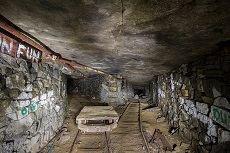
| Chert Mine in Bakewell | |
Within the same mineral fields, further resources have also been exploited, including calamine, iron ochre, and the unique ‘Blue John’ spar found local to Castleton worked from at least the mid-1700s. Further spar deposits, together with isolated workings for calcite, barite have formed the predominate focus subsequent to lead-getting, with defunct mines re-opened, and mining still occurring, with fluorspar extraction at Milldam near Eyam. Outside of this region, Derbyshire’s coal resources have also experienced intensive exploitation, with mining along the border of Nottinghamshire, the county’s northeastern limits, and in the Buxton locale, together with the South Derbyshire coalfield around Swadlincote. This extraction was long-spanning in its own right, activity recorded from the 13th Century and the last site, Markham Colliery only ceasing as late as 1994. during which iron resources were also exploited, this mining being predominantly focused around Somercotes.
Within the South Derbyshire coal reserves especially, fireclay and clay deposits have also been mined, often by multiple concerns for dedicated exploitation, to supply the potteries and manufacturing sites of Staffordshire and the West Midlands. Elsewhere, gypsum deposits have been exploited south and southeast of Derby, with Alabaster-working in the Chellaston locale forming the country’s key supplier for this resource from Medieval times, until the early 1900s. Finally, additional to surface quarrying, Derbyshire’s limestone resources have also been exploited by mining, with localised Chert worked around Bakewell until the 1960s, as too so-called ‘Black Marble’ at Ashford-in-the-Water. Whilst these being relatively small-scale, subsequent working during the latter half of the 20th Century witnessed bulk extraction, the operations at Middleton/Hopton Wood utilising heavy earthmoving plant, excavating an extensive mine by cessation in 2006.
The full range of mineral extraction reports from Terrafirma is now available as part of our Complete Search Service. For more information email michael@propertysearchgroup.co.uk or call 01246 812555
No events were found.